
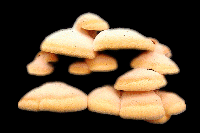


Photo by Liz Cornish

THE SULPHUR SHELF or CHICKEN MUSHROOM
Scientific name: Laetiporus sulphureus
IMPORTANT NOTICE
The TEXT on this Webpage regarding
EDIBLE WILD MUSHROOMS
is as important to your SAFETY as the photographs!
IF IN DOUBT, THROW THE MUSHROOM OUT!
I assume responsibility for the accuracy of information provided at americanmushrooms.com regarding edible wild mushrooms. However, I cannot assume responsibility for the integrity of your use of the information I present here regarding edible wild mushrooms. It is up to you to exercise your own best judgement in the event that you choose to consume edible wild mushrooms. Specifically, it is encumbent upon you to read all the text presented here that relates to the particular edible wild mushroom species involved to ensure that you have effectively ruled out dangerous poisonous/toxic wild mushrooms. Hurriedly comparing wild mushroom specimens to photographs of known edible wild mushrooms in hopes of determining that they are indeed the edible species can readily be FATAL!
Keep in mind that some of these pages include photographs of poisonous mushrooms which resemble edible wild mushroom species; again, reading the accompanying text and applying that information is absolutely vital to your safety!
Note that even with some of the best, safest, most popular edible wild mushroom species, it is possible for an individual human being to have an allergic reaction to a particular species. This happens with the grocery-store button mushroom (Agaricus bisporus), it happens with edible wild morel mushrooms, and it happens with strawberries.
It is also possible for illness to result from consuming mushrooms that are decaying, contaminated by pollution, or otherwise not in good condition. Before perusing the section of this Webpage that presents photographs of and text about edible wild mushrooms (and some of their toxic "look-alikes"!), you must read "The Mycophagist's Ten Commandments," which explains several hazards and provides advice on how to avoid those hazards.
Most importantly, be doubtful and be skeptical: Use the mushroom's description to seek evidence that the mushroom you've found is NOT the edible wild mushroom species whose photograph it resembles!
–David Fischer, Author of Edible Wild Mushrooms of North America (1992, Univ. of Texas Press)





THE SULPHUR SHELF or CHICKEN MUSHROOM
Scientific name: Laetiporus sulphureus
 |
 |
one-fourth actual size. Photo by David W. Fischer. |
Photo by Liz Cornish. |
Before I say anything else about the Sulphur Shelf or Chicken Mushroom (Laetiporus sulphureus, see photos above and below), I need to emphasize that it is very important to know what kind of tree it is growing on! Since the tree is often dead, this can be a bit tricky—but it's important because when the Chicken Mushroom or Sulphur Shelf grows on certain kinds of trees, it should be avoided! (There are actually distinct species, such as L. gilbertsonii which found on various hardwoods, primarily in California; L. conifericola, which grows on various conifers; and L. huronensis, which grows primarily on Eastern hemlock and is especially common during springtime.) Fortunately, the Chicken Mushroom or Sulphur Shelf is usually found on trunks, stumps and logs that still bear some bark, which can be the vital clue to identifying the tree—IF you can identify trees on this basis. The bottom line is that if you cannot tell the bark of a black cherry tree from that of an Eastern hemlock tree, for example, you ought to steer clear of the Chicken Mushroom or Sulphur Shelf unless it is growing on a living tree that you can identify.
SULPHUR SHELF MUSHROOMS GROWING ON ANY CONIFER TREE (PINE, HEMLOCK, SPRUCE, FIR, LARCH/TAMARACK, ETC.),
EUCALYPTUS, OR LOCUST TREES SHOULD NOT BE EATEN! Also, as with a number of wild mushrooms and many other foods (e.g. shellfish, peanuts, and milk products), some individuals have allergic reactions to this particular species.
Now that you've been duly warned, I can tell you this: Few edible wild mushrooms are considered as exciting a find as the Chicken Mushroom or Sulphur Shelf. It has a unique mushroomy flavor and a slightly grainy, meaty texture, and a single dead tree or log will often produce ten, twenty, thirty or more pounds! Because of its texture, the Chicken Mushroom or Sulphur Shelf is a fine candidate for fresh-freezing, so such a large fruiting needn't go to waste. The trick is to cut the Chicken Mushroom or Sulphur Shelf into pieces of appropriate size for the cooking pan before freezing (blanching is not necessary) and, most importantly, when you're ready to use some, do not thaw them first: have the cooking pan heating before you even open the freezer door!
As with all mushrooms, it's important to rule out other species. Fortunately, nothing else looks very much like the Chicken Mushroom or Sulphur Shelf mushroom. The upper surface of the Chicken Mushroom or Sulphur Shelf is deep orange (sometimes with salmon-pinkish areas), and the lower surface is a bright sulphur yellow. If you look very closely at the undersurface of the Chicken Mushroom or Sulphur Shelf, you'll see countless tiny pores—the open ends of the layer of tubes in which the spores are produced. The Chicken Mushroom or Sulphur Shelf does not have gills.
The Chicken Mushroom or Sulphur Shelf is especially common on large oak trees, logs and stumps, but as implied by the warnings above, it actually boasts a long list of hosts, including those mentioned above and a number of others. It's usually a benign saprobe that decays the wood of dead trees, but under the right circumstances the Chicken Mushroom or Sulphur Shelf can also thrive as a parasite of living trees. The Chicken Mushroom or Sulphur Shelf is primarily a fall mushroom, but specimens may be found from spring through autumn. Be especially wary of springtime specimens, as the visually indistinguishable L. huronensis, which typically grows on Eastern hemlock (especially during spring), has been known to cause gastrointestinal symptoms in many people.
There's a lot more information about the Sulphur Shelf or Chicken Mushroom and other choice edible wild mushrooms
in my best-selling book, Edible Wild Mushrooms of North America!
One more bit of bad news about the Chicken Mushroom or Sulphur Shelf: often, only the actively-growing edges of the "caps" are tender enough for the cooking pot… though slow, wet simmering can have a good tenderizing effect on the tougher, more fibrous parts.
L. cincinnatus is very similar, but seems to grow exclusively from buried wood (roots); it almost invariably forms rosettes that are attached to a central stalklike structure, and its undersurface is nearly white, without the yellowish coloration typical of L. sulphureus. To the best of my knowledge, it is fairly exclusive to oak. Its edible qualities are even better than those of L. sulphureus; L. cincinnatus tends to be more tender overall.
 |
 |
one-fourth actual size. Photo by David W. Fischer. |
Photo by David W. Fischer. |
There's a lot more information about the Sulphur Shelf or Chicken Mushroom
and other choice edible wild mushroom species in my best-selling book,
Edible Wild Mushrooms of North America.
AMERICA'S BEST, SAFEST
EDIBLE WILD MUSHROOMS!
HEN OF THE WOODS (also known as MAITAKE or SHEEPSHEAD MUSHROOM)
Scientific name: Grifola frondosa
THE SULPHUR SHELF or CHICKEN MUSHROOM
Scientific name: Laetiporus sulphureus
THE SHAGGY MANE MUSHROOM
Scientific name: Coprinus comatus
THE YELLOW and BLACK MORELS
Scientific names: Morchella esculenta and M. elata
THE SWEET TOOTH or HEDGEHOG Mushroom
Scientific names: Hydnum repandum and H. umbilicatum
AMERICANMUSHROOMS.COM SITE INDEX
about • mushroom basics • coolest mushrooms • edible mushrooms •
1,046 mushroom photos! • HOME • lawn & garden mushrooms • mushroom links • medicinal mushrooms
morel mushrooms • mushroom I.D. • mushroom photography • mushroom show • music • mushroom odors • psilocybin mushrooms • schedule • store • tiniest mushrooms • toxic mushrooms
To contact David Fischer, send an e-mail to…

All content at americanmushrooms.com is Copyright © 2006, 2007 by David W. Fischer. All rights reserved.