Share
AMERICANMUSHROOMS.COM SITE INDEX
about • mushroom basics • coolest mushrooms • edible mushrooms •
1,046 mushroom photos! • HOME • lawn & garden mushrooms • mushroom links • medicinal mushrooms
morel mushrooms • mushroom I.D. • mushroom photography • mushroom show • music • mushroom odors • psilocybin mushrooms • schedule • store • tiniest mushrooms • toxic mushrooms
The Death Cap
Amanita phalloides
The World's Most Dangerous Mushroom
Written and produced by David. W. Fischer
Photographs of Amanita phalloides by Fred Stevens

INDEX for this page
Introduction
"The Southeast Asian Problem"
Causes of Serious Mushroom Poisonings
Second Photo
Description of the Death Cap
Ecology and Range of A. phalloides in North America
Equally Toxic North American Mushrooms
The Destroying Angel
Toxicology and Treatment
Overreaction…?
The Truth
NO MUSHROOM is worthier of fear than the terribly poisonous Death Cap (Amanita phalloides). This single, widespread species of mushroom is solely responsible for the majority of fatal and otherwise serious mushroom poisoning cases, worldwide as well as in North America. Indeed, one might argue that the Death Cap's notorious, relatively frequent victimization of Homo sapiens is far and away the best explanation (or rationalization) for the widespread fear of edible wild mushrooms.
Ecology and Range of A. phalloides in North America
This mushroom is rare in most parts of North America but locally common in such areas as the San Francisco Bay area, where it is typically found from mid-autumn through late winter. Primarily a European species, there is no evidence that the Death Cap is native to North America. Ecologically, it is a beneficial mycorrhizal fungus—like Amanitas in general, it lives on the roots of live trees, providing phosphorus, magnesium, and other nutrients to the tree in exchange for carbohydrates.
In California, it occurs under live oak and cork trees (it apparently was brought in with cork tree seedlings, and has since adapted to native oaks). There is a similar situation in the Irondequoit area north of Rochester, New York: the Death Cap was first discovered in Durand-Eastman Park in the 1970s under Norway spruce trees that had been imported as nursery stock decades earlier. It has since been found in increasing numbers and in an ever-enlarging but still local range, under native oaks; it is rather reliably found there from late September through late October.
The Death Cap has also been reported under oaks in New Jersey and southern Oregon.
North America's "Southeast Asian Problem"
There are other mushrooms which are as poisonous—or nearly as poisonous—as A. phalloides, but this one species causes far more poisonings than the others. There is an explanation for this.
CONTINUED BELOW...
Most victims of life-threatening mushroom poisoning in North America are people from Southeast Asia—Laos, Cambodia, Thailand, Viet Nam. They apparently mistake Death Caps for edible "Paddy-Straw" (Volvariella volvacea) mushrooms. The two are similar in several ways—cap color, size, and the white "cup" around the base of the stalk—but different in others (for example, the Paddy-Straw has a pink spore print, the Death Cap a white spore print; and the Death Cap has a partial veil). The Paddy Straw mushroom occurs in tropical and temperate areas worldwide, and is especially common in Southeast Asia; the Death Cap, alas, does not occur in Southeast Asia, so folks from that part of the world are unaware of the lethal "look-alike."
In North America, Death Cap poisonings have been reported from California, Oregon, and New York. In New York, the only known victims to date were natives of Laos. In California and in Oregon, most reported Death Cap poisonings have also involved Southeast Asian immigrants.
The poisoning cases typically involve several victims—often including children—who "enjoyed" the mushrooms as a group. One or two deaths per case are common. The treatment of choice is often liver transplantation. Especially with early diagnosis, other effective treatments include massive doses of penicillin, which stimulates the liver's defenses.
The Death Cap should be sought in every part of North America where Norway spruce or cork trees have been cultivated. If found, its presence should be publicized locally, regionally, and nationally to reduce the risk of further tragedies. It is especially vital to educate communities of Southeast Asian immigrants about this lethal mushroom.
Causes of Serious Mushroom Poisonings
The "but I thought it was edible…" phenomenon, where the victims either thought they "knew" the mushroom species or applied some folk myth such as "no poisonous mushrooms grow on wood," is one of four causes of mushroom poisoning in humans.
Another often-tragic cause is similar—an individual eating a dangerously toxic wild mushroom in the belief (or with the hope) that it is a hallucinogenic species.
The most common cause of mushroom exposures, by far, is infant and toddler "grazing"—where young children ingest mushrooms as a way of experiencing their environment. (This phenomenon is also commom with domestic dogs!) Fortunately, physicians have largely abandoned the use of Epicac, which was previously commonly used even in cases in which the patient showed no symptoms and uneaten specimens were available for examination, without consulting a mycologist to attempt to determine the identity and toxicity of the mushroom.
Incredibly enough, the fourth cause of mushroom poisoning is sheer foolishness: a false presumption that most mushrooms are safe, and/or that poisonous mushrooms "look," "taste," or "smell" undesirable. (As many victims of Death Cap poisoning can attest, it is not true!)
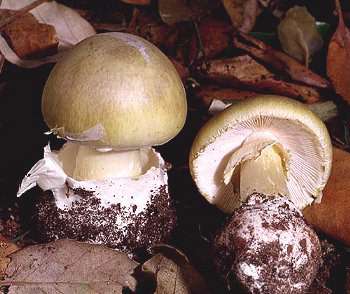
The Death Cap (Amanita phalloides): An Easy Mushroom to Identify
The Death Cap can be easily diagnosed as such.
The cap is 2¼--6" (6--16 cm) wide, smooth, with greenish to yellowish pigments, usually sticky or slippery but sometimes dry, often adorned with one to several patches of thin white veil tissue. The gills are white, crowded together, and very finely attached to the upper stalk. In young specimens, a white, membranous partial veil tissue extends from the edge of the cap to the upper stalk, covering the gills (later remaining attached to and draping from the upper stalk). The spore print is white. The stalk is white to pallid, up to 6" (15 cm) long or tall, with a large rounded bulb at the base; the bulb includes a white sac-like volva (see the two photos on this webpage). THE BASE OF THE STALK AND THE TELL-TALE VOLVA ARE OFTEN BURIED IN THE SOIL.
Equally Toxic North American Mushrooms
Amatoxins contained in the Death Cap are responsible for the symptoms suffered by its victims. They are present in all the tissues of the mushroom, in sufficient concentration that two or three grams are considered a potentially lethal dose. Several other species in genus Amanita—most notably the all-white "Destroying Angels" (A. virosa, A. bisporigera, A. ocreata and A. verna)—contain comparable levels of amatoxins. Moreover, several species of other genera of gilled mushrooms (notably Conocybe filaris, Galerina autumnalis and G. venenata, and Lepiota josserandii and L. helveola) also contain these toxins.
Conocybe filaris is a dainty, fragile species unlikely to be considered as food, but it may pose a "grazing" danger to small children and to dogs.
Galerina venenata is a small, uncommon brown mushroom sometimes found on lawns in the Pacific Northwest; it is unlikely to be considered as potential food, but it poses a "grazing" danger to small children and to dogs. Galerina autumnalis is a small brown mushroom that grows on dead/decaying wood; mushroom enthusiasts must be diligent to avoid inadvertently picking specimens of this species while harvesting more robust edbile mushrooms that grow on wood.
Genus Lepiota includes several worthwhile edible species of much larger stature than the diminutive species shown to contain amatoxins; mushroom enthusiasts must be diligent to avoid small Lepiotas, as at least one fatality has resulted from this genus in North America. (Note: a close relative of the Lepiotas—Chlorophyllum molybdites, the "Green-spored Lepiota"—contains unrelated toxins that cause severe gastrointestinal symptoms; while ingestion of this species is not generally life-threatening, it can cause dehydration severe enough to require hospitalization for fluid and electrolyte maintenance.)
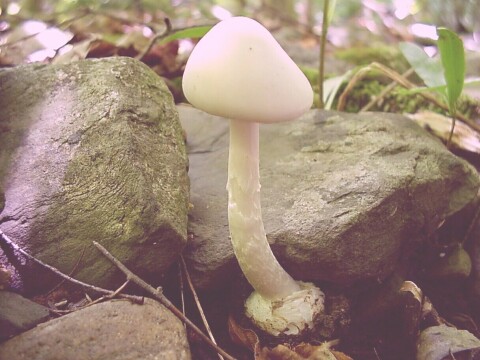 The Destroying Angel mushrooms (Amanita virosa, see photo, right) and other closely related white Amanitas have been consumed by ignorant collectors, both as food and, in at least one case, under the mistaken notion that they might be hallucinogenic.
Visually, the Destroying Angel is very similar to its more notorious brother; the most notable difference is the lack of green or yellow pigments (though some slight yellowing may be observed on some specimens). Like the Death Cap, the Destroying Angel is a very easily identified mushroom.
The cap of the Destroying Angel is 2¼--6" (6--16 cm) wide, smooth, dry to slightly sticky. The gills are crowded together and may appear either very finely attached to the upper stalk or unattached. In young specimens, a white, membranous partial veil tissue extends from the edge of the cap to the upper stalk, covering the gills (later remaining attached to and draping from the upper stalk, but it is very thin and fragile, hence is sometimes not seen on mature specimens). The spore print is white. The stalk is white to pallid, up to 8" (21 cm) long or tall, with a small, rounded bulb at the base; the bulb is enclosed by a sac-like volva. All parts of the Destroying Angel are white. THE BASE OF THE STALK AND THE TELL-TALE VOLVA ARE OFTEN BURIED IN THE SOIL.
The Destroying Angels are common and widespread throughout much of North America; the danger of these easily-identified species—and their identifying traits—ought to be widely taught in elementary school and beyond.
"Amatoxins are cyclopeptides composed of a ring of amino acids that inhibit the production of specific proteins within liver and kidney cells. Without these proteins, cells cease to function. Following ingestion…five to twenty-four hours (average, twelve hours) pass before nausea, vomiting, abdominal pain, and diarrhea begin. These initial symptoms are followed by a brief period of apparent improvement, but without treatment, severe liver damage and kidney failure often result in coma and death."
--Edible Wild Mushrooms of North America by Fischer and Bessette (1992, Univ. of Texas Press, Austin)
The delay before onset of symptoms, coupled with the intitial symptoms' mimicry of influenza and other gastrointestinal viruses and the marked (albeit temporary) improvement of most patients beginning two or three days after ingestion, pose inherent problems in prompt diagnosis and treatment.
In cases where early diagnosis is accomplished, effective therapies have included massive doses of penicillin; the use of milk-thistle extract (containing the flavinoids sylimarin/silybin/silibinin), which pharmacologically inhibits the amatoxins from effecting their most severe liver damage; and albumin dialysis (MARS-type). In more severe cases, especially those in which diagnosis is delayed further by failure to suspect amatoxin poisoning, liver transplant often becomes the only therapy offering a reasonable prognosis.
For most patients in whom diagnosis is accomplished tardily, full recovery to their states of health prior to hospitalization is very unlikely.
"The Sky is Falling!" -- Death Cap Poisonings Elicit Overreactive Statements
In California, in January, 1997, some folks picked some wild mushrooms, cooked and ate them, without knowing what they were doing… without consulting a good mushroom field guide… without carefully comparing specimens to descriptions and photos… in short, without properly identifying the mushrooms they picked.
Once again, the mushrooms they picked were "Death Caps" (Amanita phalloides).
Once again, folks ended up with serious liver damage; several of them died.
And, once again, some "authorities" spouted overreactive nonsense, not merely implying but explicitly stating that it is inherently dangerous for anyone but an "expert" to pick and eat wild mushrooms.
The Associated Press reported (1/8/97):
An outbreak of wild mushroom poisonings has sickened at least nine people in Northern California, with three victims in intensive care Wednesday facing possible liver transplants.
The most seriously ill were felled by the "death cap" mushroom, known technically as Amanita phalloides, which can destroy the liver. One victim was Sam Sebastiani Jr., 31, a member of the Sebastiani wine family.
The Mushroom Council, which represents commercial mushroom producers and importers throughout the United States, said this in a news release:
The Mushroom Council urges the public to be extremely cautious when foraging for wild mushrooms outside, especially in fields and forests, because of potential health dangers that can be caused by some wild varieties [sic]… The untrained and uneducated person can make an innocent mistake when hunting wild mushrooms that could result in illness or even death… Commercially produced mushrooms that are in your supermarket or in prepared foods are carefully cultivated agricultural products, grown year around.
This was, perhaps, neither terribly unreasonable, nor terribly overreactive. It certainly was opportunistic for the Mushroom Council to steer consumers toward their industry's produce—and away from the free foods of the forests and fields—in the capitalist tradition. No one can blame them for that. Indeed, it can be argued that some folks would hear the news stories and react with a fear of all mushrooms, including the safe cultivated species, so the Mushroom Council was merely trying to mitigate against the danger of public misperception.
(Never mind that some of the most widespread cases of serious poisoning by mushrooms in North America have been the result of botulism caused by errors in the canning of commercially cultivated mushrooms… and be sure to take a good look at those "fresh" mushrooms in the produce department of your favorite grocery store, for this "short-shelflife" commodity often shows serious signs of decay at the supermarket.)
The problem here is that "untrained and uneducated" can be misinterpreted as "lacking formal training and education in mycology"… and that is simply not true.
Rose Ann Soloway, administrator of the American Association of Poison Control Centers, had this to say (and The Mushroom Council plugged it into their news release):
It is our strong recommendation that people not pick and eat wild mushrooms unless they, in fact, are experts, or the person identifying the mushrooms is someone with whom they would trust their life.
Hmmm… "expert"? What, exactly, is an expert?
Better question: how much of an "expert" should one be to identify wild mushrooms for human consumption?
Millions of North Americans pick and eat wild mushrooms every year, without as much as a belly ache.
Are they "experts"? Yes! At least, they are experts on the edible wild mushrooms they know. Either their parents or grandparents taught them how to identify morels, or puffballs, or meadow mushrooms, or they have a good field guide and they read it… or both.
No one with a reasonable understanding of the importance of properly identifying mushrooms—with a serious awareness that some species are fatally toxic—falls victim to the Death Cap. The folks who eat Death Caps do not use field guides: they just pick the damned things and eat them. No trip to the library. No reading. No spore prints. No idea what a "partial veil" is or what "gill attachment" means.
So… Is it really dangerous to eat wild mushrooms?
How dangerous is it to drive a car? If you're drunk or careless, it is VERY dangerous; if you're sensible and pay attention, it is reasonably safe.
Consider this: Would you pick and eat an unfamiliar berry simply because it "looked good"? Of course not. Finding, identifying, preparing, and eating wild mushrooms can be a delightful pasttime—IF it is done intelligently.
Otherwise, it is a terrible "accident" waiting to happen.
Special thanks to Ben Davenport for references regarding milk-thistle extract/sylmarin therapy and MARS dialysis.
AMERICANMUSHROOMS.COM SITE INDEX
about • mushroom basics • coolest mushrooms • edible mushrooms •
1,046 mushroom photos! • HOME • lawn & garden mushrooms • mushroom links • medicinal mushrooms
morel mushrooms • mushroom I.D. • mushroom photography • mushroom show • music • mushroom odors • psilocybin mushrooms • schedule • store • tiniest mushrooms • toxic mushrooms
To contact David Fischer or submit a mushroom photo
for identification assistance, "Like" the AmericanMushrooms.com
Facebook Page
Copyright © 2006, 2018 by David W. Fischer. All rights reserved.